Articles / UFOs & sightings
A line of lights in the sky: could it be Starlink?
A row of moving dots can look extraordinary. The useful next step is to check when and where you saw it.

A satellite train is one possibility
Recently deployed Starlink satellites can appear together as a line of lights before spreading out. They are visible through reflected sunlight. SpaceX’s brightness guidance discusses how satellite orientation and surfaces affect the light reflected towards people on the ground.
That provides a candidate explanation for some observations, not an identification of every row of lights. To investigate your own sighting, match its details to independent information.
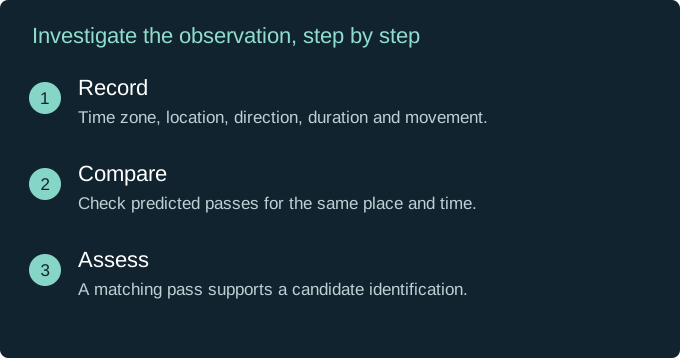
Investigate the observation, step by step. Record: Time zone, location, direction, duration and movement.. Compare: Check predicted passes for the same place and time.. Assess: A matching pass supports a candidate identification.. Select the diagram to open it at full size.
Write down the details first
Before searching for dramatic photographs, record your own memory of the event. Note the date and local time, including the time zone. Add your location, the direction you faced and roughly how long the lights remained visible.
Describe rather than interpret: “six pale points moving across the western sky” is a more useful starting note than “six spacecraft”. If the count or direction is uncertain, say so.
Use a pass prediction to test the idea
- Open a satellite prediction service such as Heavens-Above (opens in a new tab).
- Set the observing location accurately and check the displayed time zone.
- Look for relevant satellite or Starlink passes around the observation time. Historical coverage and available satellite lists vary by service.
- Compare direction and timing, not just whether a satellite existed somewhere overhead that night.
A close match supports the candidate explanation. A mismatch is a reason to check your settings and other possibilities; it is not evidence of extraterrestrial origin.
Why might the lights fade?
A satellite’s brightness depends on sunlight and geometry. Entering Earth’s shadow can remove that illumination, while changing orientation can change the reflection. SpaceX notes that lower-altitude satellites lose sunlight relatively soon after sunset or before sunrise.
When recording an event, note whether the lights faded in approximately the same part of the sky. Keep that observation separate from the explanation you later consider.
What should you keep from a phone recording?
Save the original file. Make a copy before cropping, brightening or adding annotations. Keep a note of any edits and retain a wider view that shows reference points if available.
For a follow-up description, say which details you saw directly and which appeared only when reviewing the video. That distinction helps someone else assess the record without guessing.
If no explanation fits
You can finish with “not enough information”. An investigation does not need a dramatic answer to be worthwhile. A careful record is more useful than an immediate label.
Sources and checking tools
- SpaceX: Brightness Mitigation Best Practices (opens in a new tab) — reflected sunlight and satellite brightness.
- AARO: Correlations of Starlink Satellite Flaring with UAP Observations (opens in a new tab) — satellite trains and flaring.
- Heavens-Above (opens in a new tab) — external pass-prediction tool.
Our diagram is an original checklist, not a depiction of a particular sighting.