Articles / Alien life
Where could life exist in our Solar System?
Ancient riverbeds, hidden oceans and unfamiliar chemistry: four places that make the search worth pursuing.
These worlds are research targets, not confirmed homes for extraterrestrial life. The question here is about possible environments for life, especially microscopic life—not evidence of alien civilisations.
What makes a place worth investigating?
Earth provides our working example: life uses liquid water, chemical ingredients and energy. NASA uses those requirements to help frame the search elsewhere. A world does not have to resemble a sunny Earth landscape to deserve attention.
It is useful to keep three questions separate: could an environment support life, did life ever arise there, and could we recognise its traces? Evidence for the first does not settle the other two.
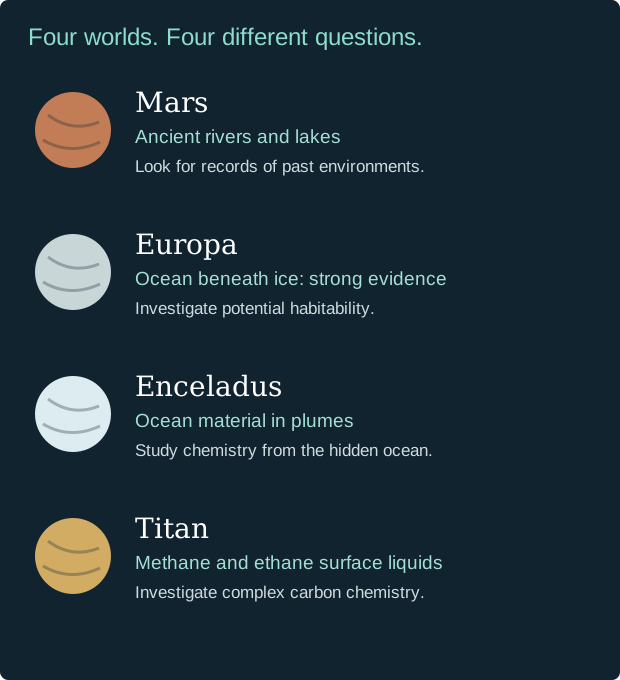
Four research targets: Mars has evidence of ancient surface water; Europa has strong evidence of an ocean beneath ice; Enceladus has ocean material in plumes; Titan has surface methane and ethane liquids and complex chemistry.. Select the diagram to open it at full size.
Mars: a record of a wetter past
Modern Mars is cold and dry, with a thin atmosphere. Evidence from missions shows a much wetter past, including ancient rivers and lakes. That makes old environments an important place to search for preserved signs of life.
The important distinction is between finding evidence of water and finding evidence of organisms. An ancient riverbed tells us about an environment; it is not a fossil by itself.
The question to follow: could particular rocks preserve a biological signal that can be distinguished from non-biological chemistry?
Europa: an ocean beneath the ice?
There is strong evidence for a saltwater ocean under Europa’s icy shell. This moon orbits Jupiter. Its hidden water and possible sources of chemical energy make it an important target for habitability research.
NASA’s Europa Clipper mission is intended to investigate whether environments below the surface could support life. Habitability is the key word: the mission’s question should not be mistaken for an announcement that organisms have been found.
The question to follow: what can observations reveal about the ocean, its surroundings and the exchange of material?
Enceladus: a hidden ocean with an outlet
Saturn’s moon Enceladus sprays icy particles and gas into space from fractures near its south pole. Cassini investigated this material, giving scientists clues to a subsurface ocean and its chemistry.
NASA describes evidence for ingredients needed by life and probable hydrothermal activity. Those findings make the ocean interesting, but ingredients are not organisms. A chemical compound associated with life on Earth may also have non-biological origins.
The question to follow: what measurements would distinguish a habitable ocean from an ocean that actually contains life?
Titan: familiar shapes, unfamiliar liquids
Titan, another moon of Saturn, has lakes and seas of liquid methane and ethane at its surface. Its rich organic chemistry makes it a useful place to investigate processes relevant to life’s origins.
Here, “organic” means carbon-based chemistry; it does not mean that something was made by an organism. Speculation about life using unfamiliar liquids should also be kept distinct from established Earth biology.
The question to follow: which chemical processes can occur there, and what could those processes teach us about the steps before biology?
Why not just choose the most promising world?
“Promising” can mean different things. One target may offer accessible samples; another may preserve ancient material; another may test a different kind of chemistry. These are different research advantages, not a single scoreboard.
Imagine choosing where to investigate a mystery in your own town. The place easiest to visit is not automatically the place most likely to contain the answer. Access, evidence quality and the question you can test all matter.
How to read the next discovery headline
Look for the actual measurement before the interpretation. Did researchers detect a molecule, infer a body of water, or identify a possible biological pattern? Then ask what other processes could produce the same result.
A useful headline can leave a question open. Discovering that an environment could support life would be a meaningful result, even without discovering life itself.
For a different scale of question, try the Drake equation explorer, which concerns detectable technological civilisations across the galaxy. It does not estimate whether these four worlds contain microbes.
Sources and further reading
- NASA: environments beyond Earth that could be habitable (opens in a new tab)
- NASA: Mars facts (opens in a new tab)
- NASA: Europa (opens in a new tab)
- NASA: Enceladus (opens in a new tab)
- NASA: Titan (opens in a new tab)
This is a selected introduction, not an exhaustive list of Solar System research targets.