What If? / Europa
What if there is life beneath Europa’s ice?
The first thing the camera finds is a stone. The second makes everyone in the control room stop talking.
The ocean without a sky
By the time the picture reaches Earth, whatever happened beneath Europa’s ice has already happened. The team cannot steer around a rock with a quick movement of a joystick. They write instructions, wait, and trust the small machine to make decisions in the dark.
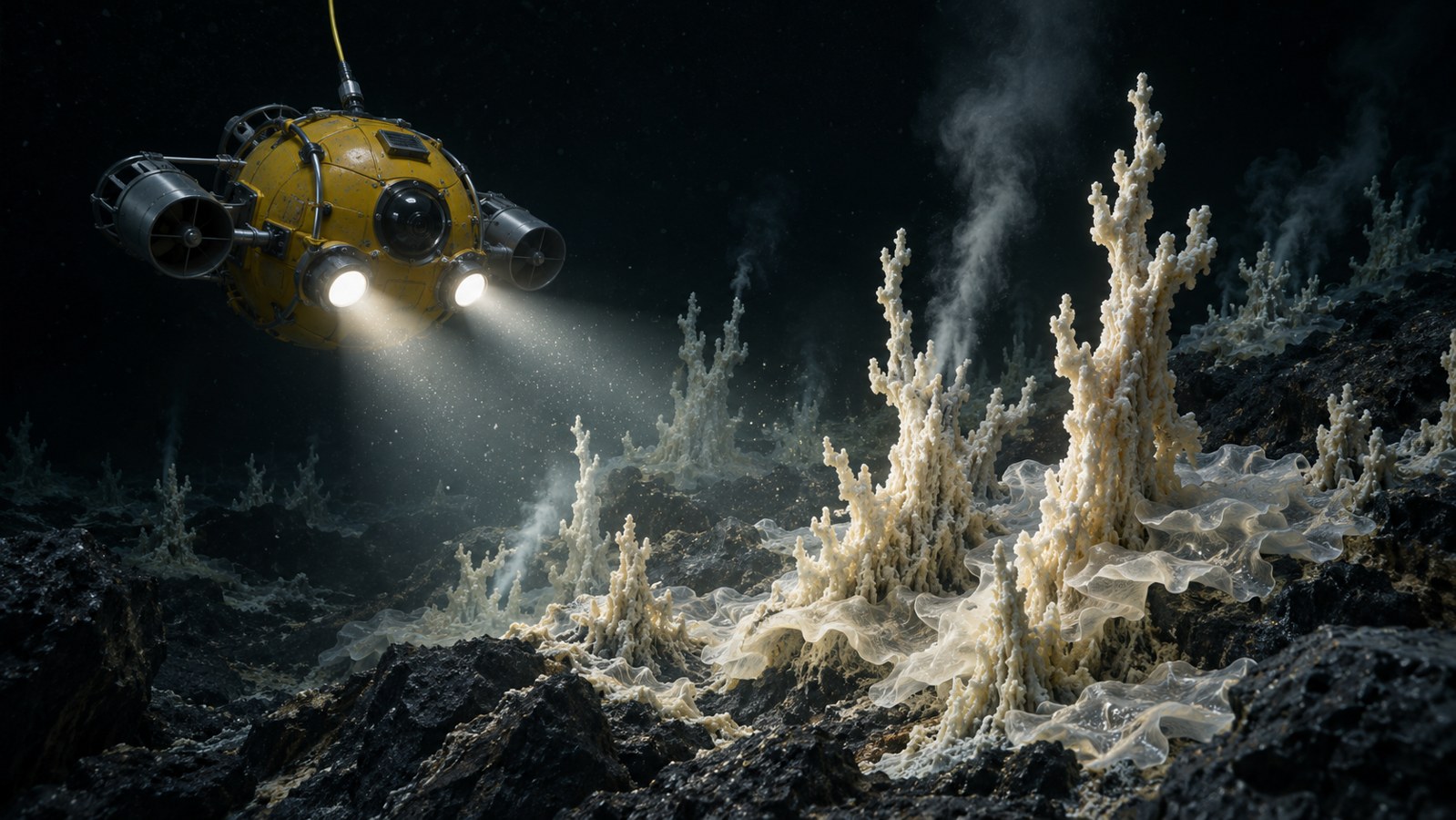
The robot is called Lantern. Two white lamps, a camera dome, a pair of thrusters and a cable disappearing into the water above it. Years of engineering have brought it here. In its first clear image, a pebble sits on a larger stone.
Nobody is disappointed. It is a stone on the floor of an ocean that no human being has seen.
Lantern moves forward. Its lights sweep across a ridge of black rock, then a cluster of pale mineral spires. There is no grand smoking chimney. Only a faint distortion in the water, a slow leak of fluid that the instruments notice before the camera does.
At the base of one spire, something lies in folds.
A movement worth checking
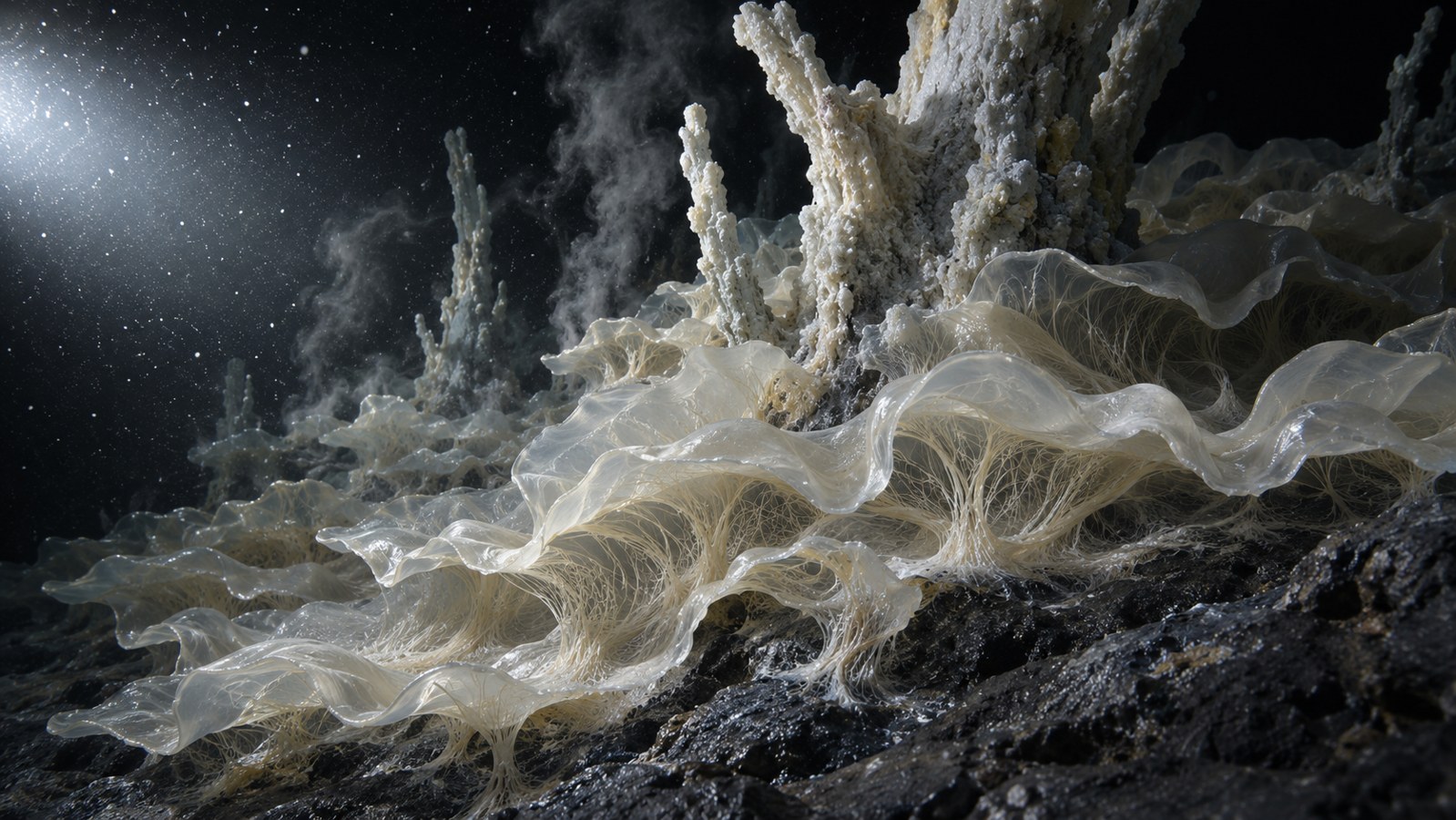
At first, the folds look like mineral deposits: ivory layers with translucent edges. The nearest one lifts as the vehicle passes, then settles.
“Current,” says someone. They are right to say it.
The robot backs away. Sediment drifts through the beam. The team marks the sequence and asks Lantern to observe from a new angle. A second fold rises. A third draws inward before the water around it visibly changes.
The room becomes quiet, but nobody says “life”. Not yet.
They ask whether the lamps have warmed the surface. Whether the thrusters disturbed it. Whether flexible mineral films could produce the same effect. The questions make the scene more extraordinary, not less. For once, the answers might be waiting in another image.
A garden that has never seen sunlight
Over the following weeks, Lantern maps the ridge. In this imagined ocean, the colonies occur where chemically different waters meet. The folds increase the surface available to that passing water. Their food begins with chemical reactions, not sunlight.
They have no leaves, no flowers and no green canopy. Calling the place a garden is a human habit. It is really a patchwork of living surfaces, separated by long reaches of apparently bare stone.
The largest sheet is no wider than a dinner plate. Its fine threads anchor it to the rock. Under stronger light it appears almost colourless. With Lantern’s lamps switched off, the camera sees nothing. This world has no obligation to glow for its visitors.
The sample that changes the conversation
Movement alone cannot settle the question. Lantern collects a minute sample with its sealed instrument arm, alongside water and rock samples from a nearby empty site. The team checks the controls as closely as the strange material.
In the story, successive measurements reveal repeating compartments, organised chemistry and changes that continue when fresh fluid passes over the sample. The evidence builds gradually. Each new result is sent to other teams. Some dispute the interpretation; others design tests that the first team has missed.
There is no single screen that flashes LIFE DETECTED.
Eventually, the explanation that fits best is the one the team hardly dared to write at the beginning: Lantern has found organisms. Their next question is whether this biology arose independently of life on Earth. The sample does not answer that merely by looking unfamiliar.
A discovery without a face
The first public image is disappointing to some people. No silver animal. No great eye opening in the dark. Only pale folds beneath a machine’s white lamp.
But consider what the picture means in this fictional future. Another world has turned chemistry into living organisation. An ocean without a sunrise has a history that did not need us to watch it.
Lantern turns towards the next ridge. Its cable pulls gently overhead. The lamps reveal a second pale patch, then another beyond it.
For the people on Earth, the universe has changed. Down here, the water keeps moving.
Where science ends and this story begins
The scientific foundation
Europa has strong evidence for a saltwater ocean beneath its icy shell. Liquid water, suitable chemistry and an energy supply make it an important habitability target. Sunlight would not reach a deep ocean beneath thick ice, so any ecosystem there would need another energy source. NASA discusses chemical energy as a possibility, not proof that an ecosystem exists.
The choices we invented
Lantern, the ocean-access mission, the mineral ridge and every organism are fictional. We chose low folded colonies to imagine a life form with a large exchange surface. We do not know that Europan life would have cells, sheets, these colours, or any recognisable anatomy. The discovery sequence is storytelling, not a validated life-detection procedure.
An important uncertainty
The energy available at Europa’s seafloor is unresolved. A 2026 modelling study argues that active faulting there is unlikely today, challenging some Earth-style hydrothermal scenarios. It does not settle every possible energy pathway. Our fictional fluid-fed colony is a creative assumption, not a forecast from that research.
What the real mission does
Europa Clipper investigates whether Europa has conditions that could support life. It is not the fictional ocean-diving robot in this story. Finding a potentially habitable environment would be significant without demonstrating that life actually arose there.
Science sources
- NASA: Europa facts (opens in a new tab)
- NASA: Why Europa—ingredients for life (opens in a new tab)
- Byrne et al. (2026): Little to no active faulting likely at Europa’s seafloor today (opens in a new tab)
Scientific background reviewed 4 November 2026. Sources support the science note, not the fictional discoveries.