Articles / Alien life
What is the habitable zone?
Being the right distance from a star is a promising start. It is not a discovery of oceans—or life.
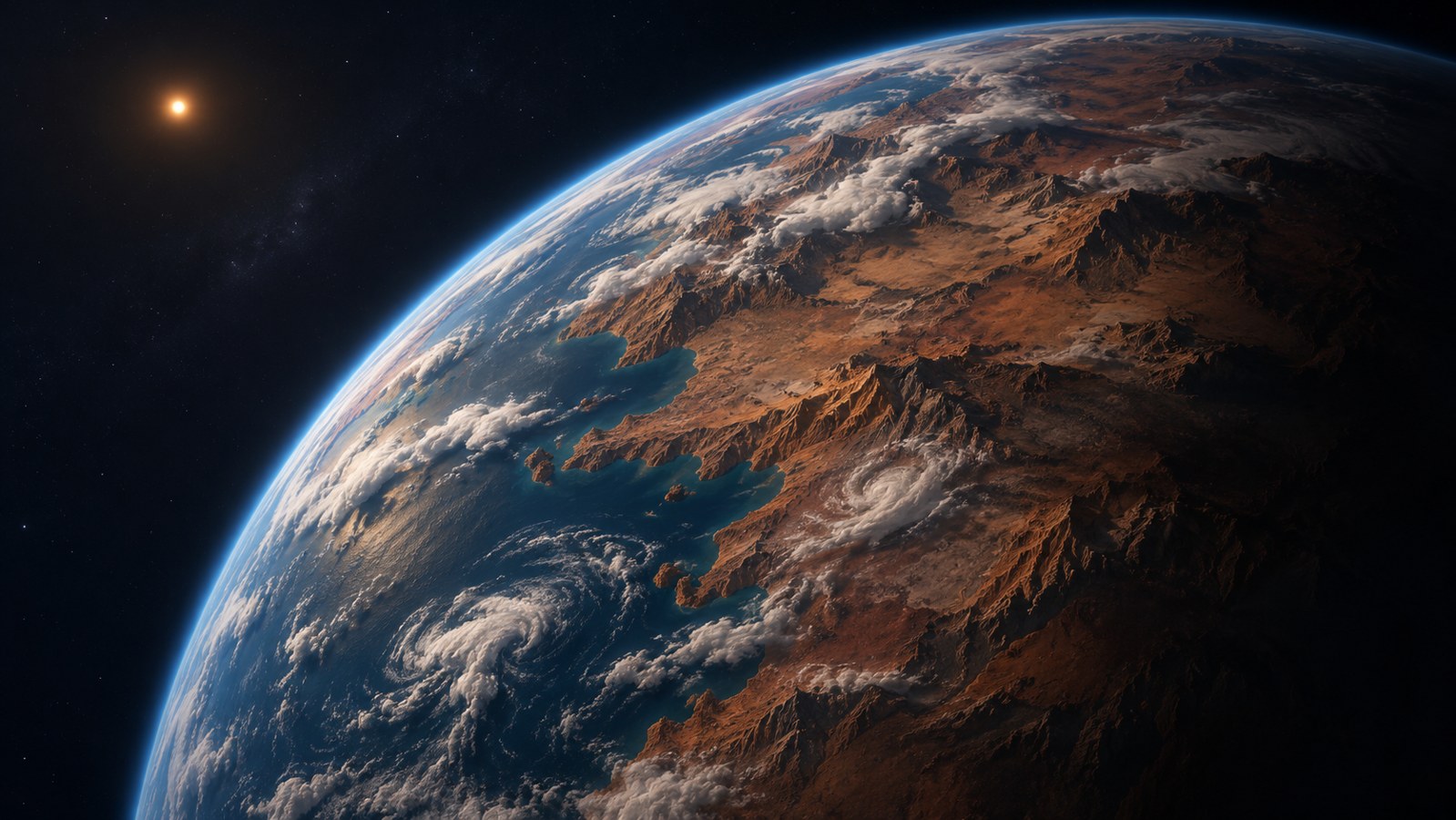
The habitable zone is the range of distances from a star where a planet with suitable atmospheric conditions could support liquid water on its surface. It is sometimes called the Goldilocks zone. Being inside it does not establish that a planet has water, a suitable atmosphere or life.
Why “Goldilocks”?
The nickname evokes a temperature that is neither too hot nor too cold. Move a planet closer to its star and it receives more stellar energy; move it farther away and it receives less. Under particular climate assumptions, a middle range could allow surface water to remain liquid.
This is a way to identify interesting targets, rather than a simple thermometer for every planet. The zone’s boundaries depend on the star and on the planetary conditions assumed by a model. They are not a visible ring in space. See source 1.
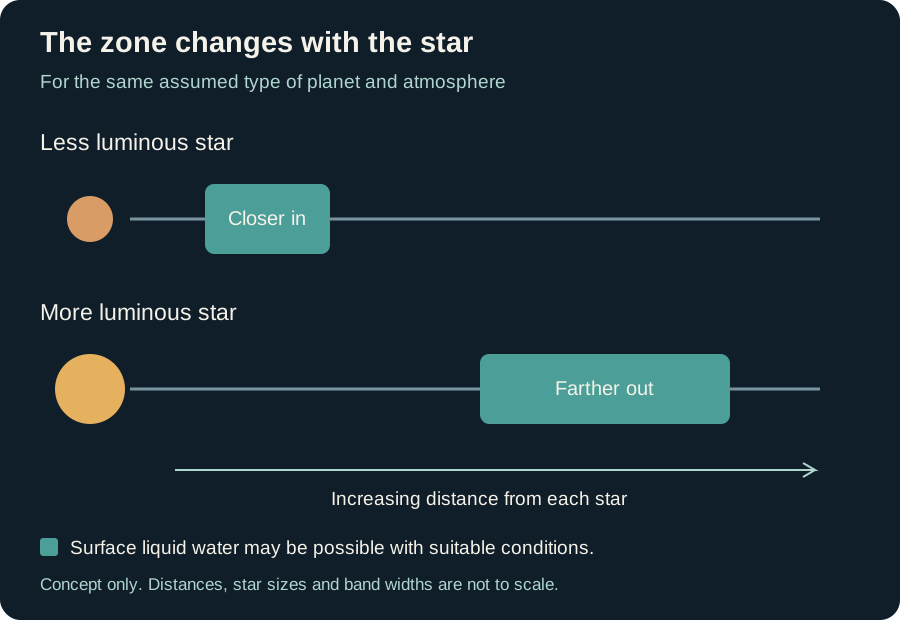
A less luminous star’s habitable zone lies closer in. A more luminous star’s zone lies farther out. In either case, suitable atmospheric conditions are still needed for surface liquid water. Select the diagram to view it full size.
Why does the star make a difference?
There is no universal “Earth distance” that makes a planet suitable for life. Around a less luminous star, the comparable receiving zone lies closer to the star; around a more luminous one, it lies farther away.
Red dwarfs illustrate why distance is only one part of the question. Their close-in planets can face strong stellar activity. Researchers are investigating whether rocky worlds around these stars can retain atmospheres despite that environment. A temperate orbit is much less useful if the planet has lost the air needed for its surface climate. See source 2.
The atmosphere can change the answer
A planet’s surface temperature depends on more than the energy arriving from its star. Atmospheric composition and pressure, greenhouse warming, clouds and reflection of incoming light all affect the climate. A bare rock and an ocean world with an atmosphere need not have the same conditions at the same orbital distance.
That is why “Earth-sized” does not mean “Earth-like”. Size alone does not reveal air pressure, surface water or a climate suitable for biology. A useful assessment combines information about the planet, its atmosphere and its star. See source 3.
What have we actually observed?
When a planet passes in front of its star, astronomers can study how starlight changes. If light passes through an atmosphere, different molecules can leave patterns in the spectrum. Those patterns are difficult to measure and interpret, especially for small planets.
NASA’s Webb discussion explains that stellar features can complicate the task: a water-vapour signal might come from the star rather than the planet. Even a genuine atmospheric detection would need context before it established surface oceans. See source 4.
A helpful headline should distinguish a measured property from an inference. An orbit may be well constrained while the atmosphere remains unknown. A picture showing blue seas can still be an artist’s impression, rather than a resolved photograph.
Could life exist outside the habitable zone?
The conventional zone concerns surface liquid water under particular assumptions. It is not a map of every possible environment for life. Water beneath an insulating ice shell may remain liquid with help from internal energy, even where the surface is very cold.
Our own Solar System supplies important examples: Europa and Enceladus are investigated as ocean worlds beyond the Sun’s conventional surface-water zone. Their possible or established subsurface oceans do not establish that organisms live there. See source 5 and our Solar System life guide.
Habitable, inhabited and detectable are different
- Potentially habitable: available evidence or a model suggests some conditions could support life.
- Inhabited: life actually exists there. Suitable conditions alone do not establish this.
- Detectable: any signs of life can be measured and distinguished from other causes with our instruments.
These are separate questions. A promising environment might be lifeless; a living world might offer no clear signal to a distant observer. Keeping the questions separate helps us read discoveries without either dismissing them or overstating them.
Three questions for the next discovery headline
- Does “in the habitable zone” describe an orbit, or have atmospheric conditions also been measured?
- Is water detected, inferred as possible, or merely shown in an illustration?
- Does the evidence concern conditions suitable for life, a possible biological clue, or a verified discovery?
The habitable zone remains a useful starting filter. The interesting work begins when we ask what a particular planet is really like. For the larger question of technological societies, explore the Drake equation; for possible observable clues, see Could aliens detect Earth?
Sources and further reading
- NASA: What is the habitable zone or Goldilocks zone? (opens in a new tab) — Definition and stellar context.
- NASA: Can rocky worlds orbiting red dwarf stars maintain atmospheres? (opens in a new tab) — Stellar activity and atmosphere retention.
- NASA SEEC: What makes a planet habitable? (opens in a new tab) — Climate, atmosphere and interacting factors.
- NASA Webb: Reconnaissance of potentially habitable worlds (opens in a new tab) — Atmospheric observations and their limits.
- NASA: Ocean worlds (opens in a new tab) — Subsurface water and internal energy in the Solar System.
Reviewed 4 November 2026. This guide concerns habitability as understood for life using liquid water; it does not claim to describe every conceivable form of life.