Articles / Alien life
Could aliens detect Earth?
Turn the telescope around. What clues could our world offer to someone looking in this direction?

Detecting a planet is not the same as detecting its inhabitants
There are several different questions here: could an observer find Earth, infer that it supports life, or identify technology? A clue to one is not automatically an answer to the others.
Scientists call potential signs of technology technosignatures. NASA describes searches involving radio, unusual atmospheric chemistry and artificial light. These are research possibilities, each with different observational demands.
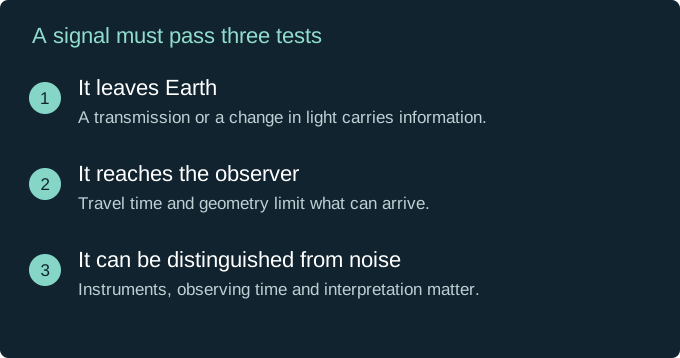
A signal must pass three tests. It leaves Earth: A transmission or a change in light carries information.. It reaches the observer: Travel time and geometry limit what can arrive.. It can be distinguished from noise: Instruments, observing time and interpretation matter.. Select the diagram to open it at full size.
Which clues might stand out?
Radio emissions can be examined for patterns that suggest technology. Atmospheric chemicals might offer another route; researchers also consider artificial illumination. A bright city in a close-up artist’s impression, however, is not what a real distant telescope necessarily resolves.
The relevant question is not simply whether something exists on Earth. It is whether the light or signal could be separated from other sources and measured with the observer’s instruments.
What a 2025 study explored
A team led by Sofia Sheikh compared several Earth technosignatures in a modelling study. It asked what an observer using technology comparable to ours could detect. Powerful planetary radar was especially detectable in the scenarios studied; other signatures required much closer observing distances.
These were conditional detection calculations, not evidence that anyone has observed us. A result for one transmitter, receiver and observing geometry cannot be applied to every household radio device.
Three questions for any dramatic headline
Which signal is being discussed?
Check whether the claim concerns a strong directional transmission, weak everyday leakage, a chemical measurement or reflected light. A single phrase such as “Earth’s signals” can conceal very different examples.
What is the assumed observer capable of?
Look for the receiving instrument, sensitivity, integration time and signal-selection rules. “Detectable” has meaning only in relation to an observing setup.
Was the observation possible at the right time?
An observer cannot receive a transmission before it arrives. Nor does receiving a signal once guarantee that it will repeat during a follow-up observation.
A nearby conversation is still a slow one
In a fixed-distance example, a message crossing 10 light-years needs 10 years to arrive. An immediate response needs another 10 to return. The calculation says nothing about whether a receiver exists or whether the transmission can be detected.
What can we conclude?
Our planet offers researchers a useful example for thinking about observable technology. It cannot tell us what an unknown civilisation would build, notice or choose to investigate.
When someone says “aliens could see us”, ask them to finish the sentence: see what, from where, with which instrument? Those details turn an exciting possibility into a question that can actually be examined.
Sources and further reading
- SETI Institute: Earth Detecting Earth (opens in a new tab) — the February 2025 modelling study and its scope.
- NASA: Searching for Signs of Intelligent Life (opens in a new tab) — types of proposed technosignatures.
The diagram illustrates reasoning steps, not measured detection ranges.