Articles / Alien life
The Wow! signal: what did we detect?
Six characters on a computer printout became famous. They record an unusual observation—not a decoded alien message.
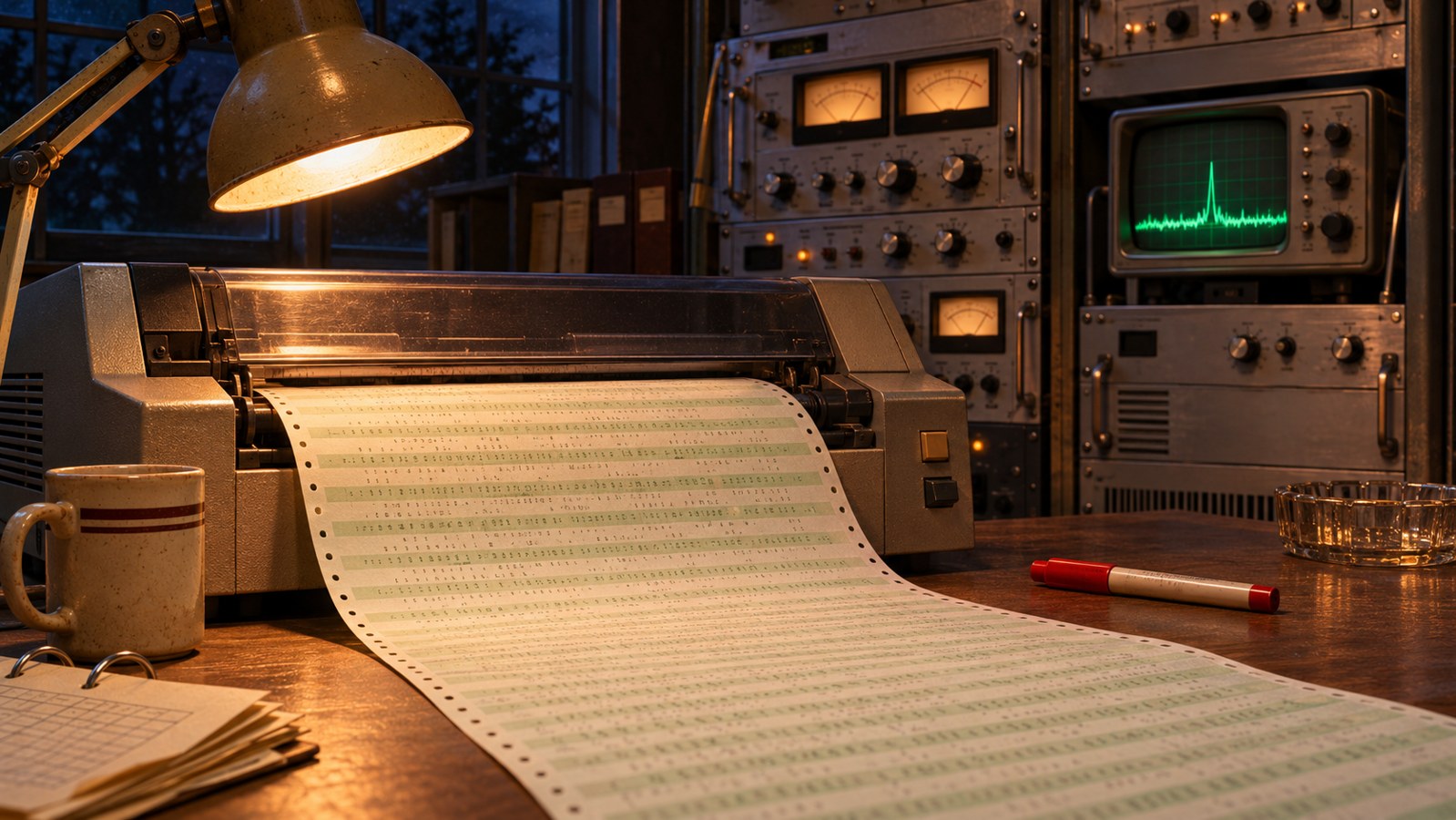
The Wow! signal was a strong, narrowband radio observation recorded by Ohio State University’s Big Ear telescope on 15 August 1977. It has not been confirmed as an extraterrestrial transmission. Its source remains unidentified.
Why was it called “Wow!”?
While reviewing the telescope’s printed data, volunteer astronomer Jerry Ehman spotted an unusually strong sequence. He circled it and wrote “Wow!” beside it. The annotation supplied a memorable name for an observation that still invites investigation.
The signal grew stronger and then weaker in a pattern consistent with a source moving through the telescope’s observing beam as Earth rotated. That was an interesting feature, but it did not identify the source or establish that someone was sending a message. See source 1.
What does 6EQUJ5 mean?
The characters represent six successive measurements of signal strength in one frequency channel. They are not six letters or digits received from a transmitter. Big Ear’s computer converted the measurements into compact symbols to save space on the printout.
In Ehman’s explanation, the values are scaled above the channel’s background baseline using its noise variation. Digits represent the lower ranges; letters continue the scale, with A starting at 10. Thus E represents 14 to below 15, and U represents 30 to below 31. U was the peak in this sequence—not the upper limit of the entire coding system. See source 2.
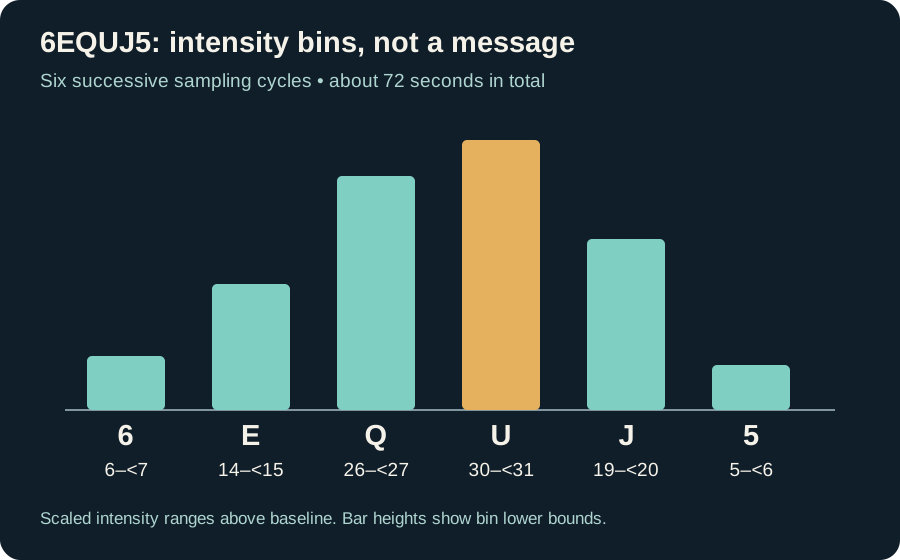
6 → 6–<7; E → 14–<15; Q → 26–<27; U → 30–<31; J → 19–<20; 5 → 5–<6. These are scaled intensity ranges, not message content.
Did it last exactly 72 seconds?
The famous sequence covers six roughly 12-second sampling cycles: about 72 seconds altogether. Each cycle included approximately ten seconds of measurement and two seconds of processing. That describes the recorded sequence, not a known transmitter’s complete operating time. The observation does not tell us that a source deliberately switched on for precisely 72 seconds. See source 6.
Why did the frequency matter?
The observation was near the 1,420 MHz region associated with neutral hydrogen’s 21-centimetre radio emission. This is an important astronomical reference, but proximity to it is not a signature of intelligence by itself. “Narrowband” means concentrated within a small frequency range, rather than spread broadly across the radio spectrum.
A signal’s frequency, strength and time pattern are clues to examine together. A plausible-looking clue still needs checks against natural processes, human interference and the instrument’s behaviour.
Have follow-up searches found it again?
No confirmed repeat has identified the original source. One targeted search used the Green Bank Telescope and Allen Telescope Array in May 2022 to investigate a proposed Sun-like source star. Breakthrough Listen reported no technosignature candidates from those observations. See source 3.
That does not rule out every star in the original observing region, every frequency or every possible transmission schedule. It tells us what this particular search did not detect. Nor does choosing an interesting star establish that the 1977 signal came from it.
Could there be a natural explanation?
Yes. In a 2024 research preprint, Abel Méndez and colleagues reported weaker, narrowband hydrogen signals in archived Arecibo observations. They proposed that a sudden brightening of a hydrogen cloud, triggered by a transient radiation source, could explain the much stronger Wow! event. This is a hypothesis to test, not an observation of the proposed 1977 trigger. See source 4.
A separate 2025 preprint from the project re-examined archival Ohio SETI data and revised estimates of the signal’s position, strength and frequency. The authors argue that the results favour an astrophysical origin. Their interpretation should be distinguished from a confirmed identification of the original source. See source 5.
It is possible to improve the measurements while leaving the central question open. A useful next step is evidence that separates competing explanations, rather than another dramatic retelling.
Can we listen to the Wow! signal?
The six printed symbols are measurements, not an audio recording of a voice, tune or language. An online sound clip may convert data into audible tones or add an imagined soundscape. Check its description before treating it as something the telescope literally heard. Our chart similarly visualises recorded ranges; it does not reveal hidden content.
What does it tell us about aliens?
It demonstrates why a striking observation and a verified discovery are different stages. Repeated observations, independent instruments and a clear account of alternatives would make a much stronger case than a single unexplained event.
The broader question connects to our Fermi paradox guide. For another kind of possible technological clue, explore Dyson spheres and infrared searches. Neither question requires us to treat uncertainty as proof of visitors.
Sources and further reading
- SETI Institute: The Wow! Signal (opens in a new tab) — Overview and historical context.
- Jerry Ehman: Explanation of the Code 6EQUJ5 (opens in a new tab) — First-person explanation of the coding scale and sampling.
- Breakthrough Listen: Search for the Wow! Signal (opens in a new tab) — The May 2022 targeted observations and their limits.
- Méndez et al. (2024): Arecibo Wow! I (opens in a new tab) — Research preprint proposing an astrophysical explanation.
- Méndez et al. (2025): Arecibo Wow! II (opens in a new tab) — Research preprint reanalysing archival Ohio SETI data.
- Jerry Ehman: 30th Anniversary Report (opens in a new tab) — Observing method, timing and interpretation.
Research status checked 4 November 2026. Proposed explanations are presented as proposals, not a settled solution.