Articles / Alien life
How many civilisations could be out there?
The Drake equation is a way to organise a question. Its answer depends on what you put into it.
Seven factors. One very uncertain answer.
Frank Drake introduced his equation in 1961 as a framework for discussing the search for extraterrestrial intelligence. It estimates the average number of civilisations in our galaxy producing detectable electromagnetic signs.
N = R* × fp × ne × fl × fi × fc × L
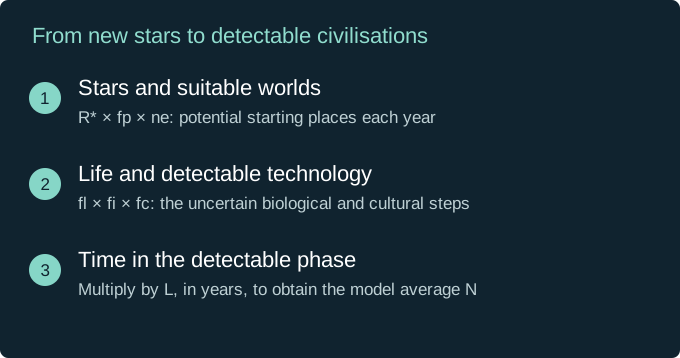
From new stars to detectable civilisations. Stars and suitable worlds: R* × fp × ne: potential starting places each year. Life and detectable technology: fl × fi × fc: the uncertain biological and cultural steps. Time in the detectable phase: Multiply by L, in years, to obtain the model average N. Select the diagram to open it at full size.
What the symbols mean
R* counts suitable stars forming per year. fp is the fraction with planets; ne is the average number of suitable worlds per system. fl, fi and fc represent the fractions progressing to life, intelligence and detectable technology. L is the average duration of detectable signs, in years.
Those last steps are deeply uncertain. Knowing that a world could support life does not tell us whether it does, or whether a technological civilisation will emerge there.
Explore the equation yourself
Change the assumptions and see how the model result changes in our standalone calculator.
Open Drake equation calculator →A worked example you can check
Our starting choices multiply to 10: 1 × 1 × 0.2 × 0.5 × 0.1 × 0.1 × 10,000. This is an arithmetic example, not a discovery of ten civilisations.
Try changing only fl from 0.5 to 0.001. The result becomes 0.02. Now restore the starting example and increase only L to 1,000,000: the result becomes 1,000. Neither experiment supplies evidence for those assumptions. It shows how much the answer depends on them.
Does 0.02 mean part of a civilisation?
No. It is a model average. An average can be fractional even when individual things are counted in whole numbers. It is not automatically a 2% probability, and it is not an inventory of known societies.
Likewise, a large answer does not promise an easy conversation. N does not specify locations, signal strengths, observing schedules or distances. Our message calculator explores one of those separate difficulties.
Use it as a question generator
After trying an example, name the assumption you would most like to investigate. Then ask what kind of observation could improve it. The calculator is most useful when it makes the uncertainty clearer, rather than hiding it behind a precise-looking number.
Sources and model notes
- SETI Institute: Drake Equation (opens in a new tab) — history, definitions and uncertainty.
- Berkeley SETI: the Drake equation (opens in a new tab) — the seven-factor formulation.
This uses the classic simplified steady-rate model. It is not a time-dependent population simulation. Input ceilings are interface limits, not scientific bounds. All presets are editorial teaching examples.