Articles / Alien life
What is a Dyson sphere?
Could a civilisation collect a star’s energy—and leave a trace that we could see?
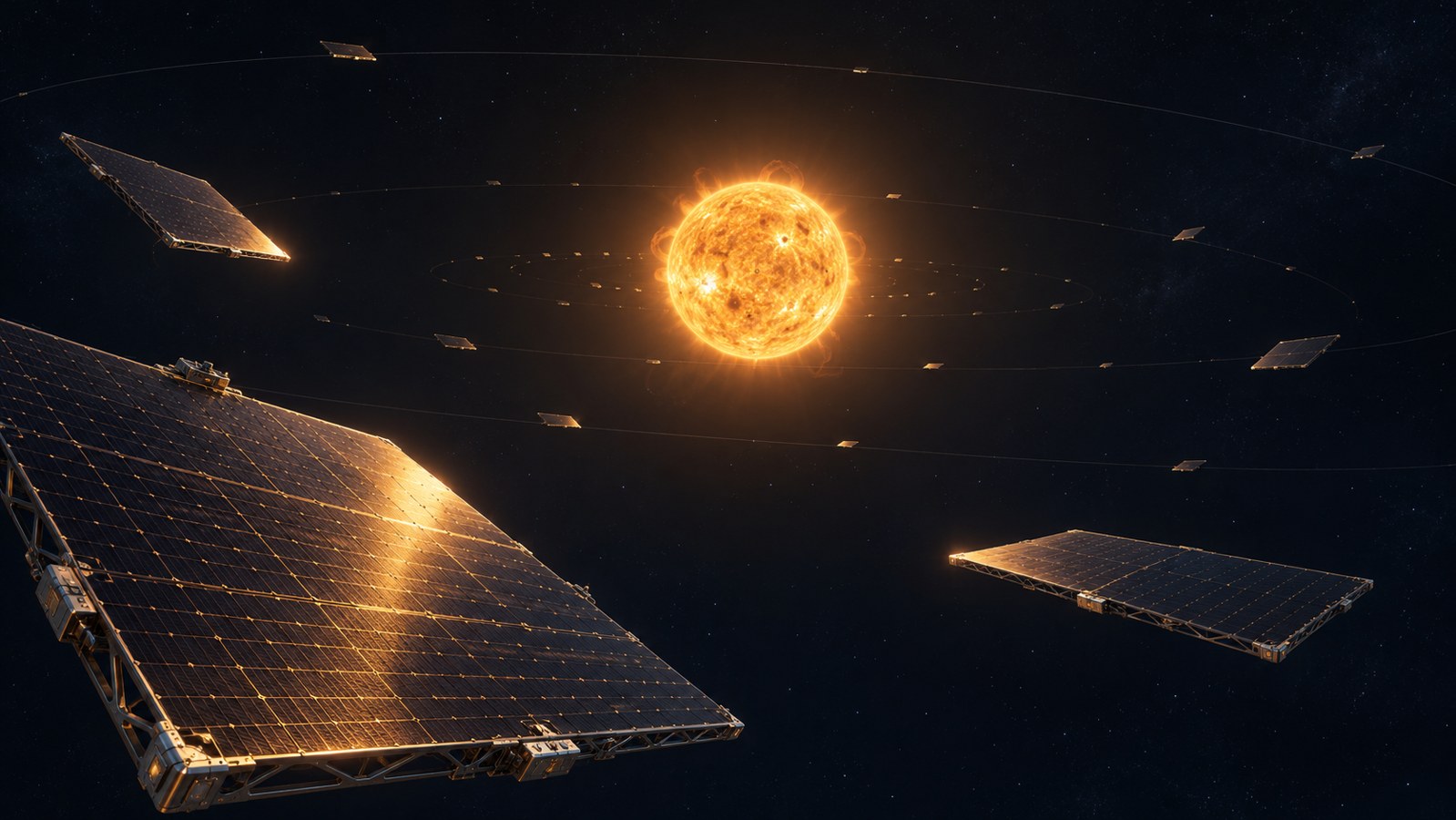
A Dyson sphere is a hypothetical system that collects a substantial share of a star’s energy. A Dyson swarm would use many separate orbiting collectors rather than a solid shell. No Dyson sphere has been confirmed.
Why collect energy around a whole star?
Solar panels on Earth intercept only the sunlight that reaches their surfaces. Imagine taking that collecting idea into space and increasing its scale far beyond a single planet. Instead of relying on a small patch of ground, an advanced civilisation might place collectors around its star.
That is a thought experiment, not a forecast of what humanity will build. It asks an astronomical question: if large-scale energy use were happening elsewhere, could its consequences appear in our telescope data?
In 1960, physicist Freeman Dyson proposed looking for infrared radiation associated with advanced technology’s conversion of starlight. His important insight concerned a possible observable consequence of energy use, rather than a detailed construction blueprint. See source 1.
Dyson sphere versus Dyson swarm
The name can bring to mind an enormous hollow ball enclosing a star. That familiar science-fiction image is not the only interpretation—and a rigid shell has severe mechanical and stability problems.
A swarm is different: individual structures travel on their own orbits, with space between them. There need not be a solid surface to stand on, or complete coverage that hides the star. Dyson clarified that he had envisaged separate orbiting objects. See source 2.
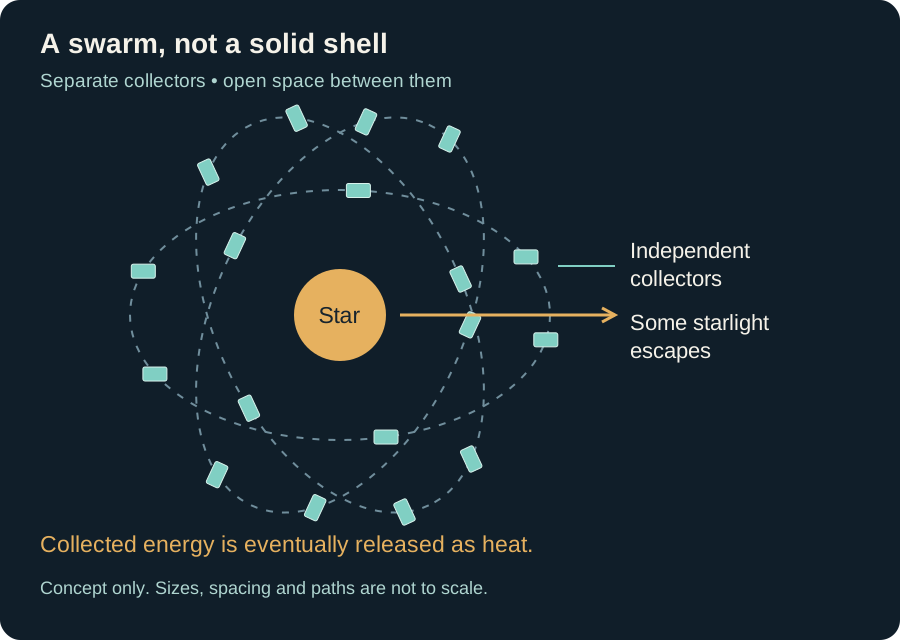
Separate collectors orbit the star. Gaps allow some starlight to escape. Collected energy is eventually released as heat. Select the diagram to open it at full size.
Could we build one?
A swarm avoids the need for a single rigid shell, but it does not remove the engineering challenge. Manufacturing, material supply, orbital management and heat disposal would all matter. Collectors would also need arrangements that avoid destructive encounters.
There is no demonstrated construction programme for a star-enclosing swarm. Calling one physically interesting is not the same as showing that it is affordable, stable over long periods or desirable to its builders. Nor should we assume that every technological society would pursue ever-greater energy consumption.
How could astronomers detect a Dyson sphere?
The search need not depend on seeing individual panels. A system that absorbs starlight and uses its energy must dispose of heat. Depending on its temperature, that heat could emerge strongly at infrared wavelengths.
Astronomers therefore compare a source’s measured light with what they expect from a star. Extra infrared emission can flag an object for investigation. A partial swarm could leave visible starlight as well as infrared emission; a candidate does not have to look like a completely missing star. See sources 2 and 3.
This would be a possible technosignature: an observable clue that might be associated with technology. Our article Could aliens detect Earth? explores the same reasoning from the opposite direction.
Have scientists found any?
Researchers have identified objects worth following up, which is a different claim from discovering alien engineering. In 2024, Project Hephaistos reported seven candidates after filtering observations of five million objects from the Gaia, 2MASS and WISE surveys. The shortlisted stars were M dwarfs, with more infrared emission than expected. See source 3.
Natural material around stars can also produce infrared emission. A distant galaxy nearly aligned with a foreground star can blend into the same measurement. Before calling an excess artificial, researchers must examine those explanations and the limits of the observations. See source 4.
A follow-up that changed the picture
A July 2026 research preprint reports James Webb Space Telescope observations of two Hephaistos targets, labelled D and E. The authors attribute their infrared excesses to background galaxies, rather than structures around the stars. This result concerns those two targets; it does not settle every possible search for stellar energy collectors. See source 5.
How to read the next “alien megastructure” headline
- Find the measurement. Is it excess infrared light, changing brightness or something else?
- Check the alternatives. Could dust, an overlapping source or a measurement problem explain it?
- Look for follow-up. Did sharper imaging or spectroscopy resolve the uncertainty?
“Compatible with a model” means an idea can fit some observations. To favour it over another explanation, we need evidence that helps distinguish them. A candidate is an invitation to investigate.
Dyson spheres make the Fermi paradox more concrete: what signs should we expect, and which have we actually searched for? An unsuccessful search limits the kinds of systems it could have detected. It cannot prove that technological life is absent everywhere.
Sources and further reading
- Dyson (1960): Search for Artificial Stellar Sources of Infrared Radiation (opens in a new tab) — Original proposal.
- Wright (2020): Dyson Spheres (opens in a new tab) — Review of the history, engineering and detectability; PDF.
- Suazo et al. (2024): Project Hephaistos II (opens in a new tab) — Original candidate search; published in MNRAS.
- SETI Institute (2025): Have We Really Detected Dyson Spheres? (opens in a new tab) — Infrared excess and natural explanations.
- Zackrisson et al. (July 2026): Project Hephaistos IV (opens in a new tab) — Research preprint reporting JWST follow-up of candidates D and E.
Research status checked 4 November 2026. The cover and diagram illustrate a hypothesis; neither depicts a detected system.