What If? / Nera
Welcome to Nera
An amber sun. A coast of living arches. A civilisation that listens through its feet.
The tide that failed to return
Keeper Seli closes a familiar crossing when the basin stays empty. The apprentice hears something moving beneath the road.
Read the first story →The coast of living arches
Nera is a fictional rocky planet with oceans, ordinary days and nights, and an amber-coloured star. It is not assigned to a real star system. Our first visit stays close to one shallow basin: Nereth inlet.
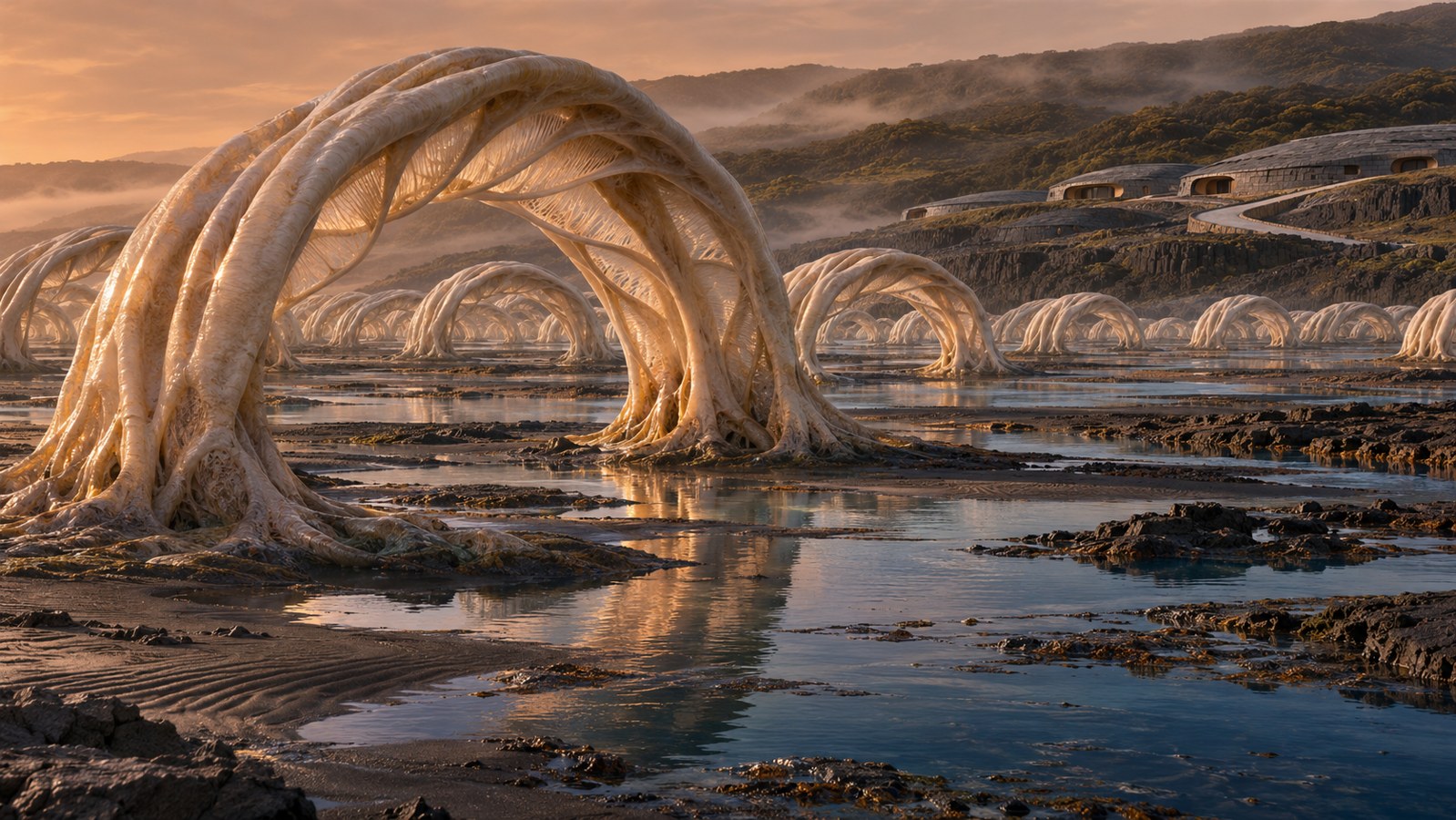
At low water, wet black sand reflects pale arches about four metres high. Each arch is a rooted organism, with two broad bases supporting a ribbed vault. Fine membranes filter material carried by the water. When the flow deepens, those membranes draw inward.
The arches form an ecosystem, not a planned city. The Vey build their crossing among them and maintain the channels that keep the basin connected to the outer sea.
The Vey
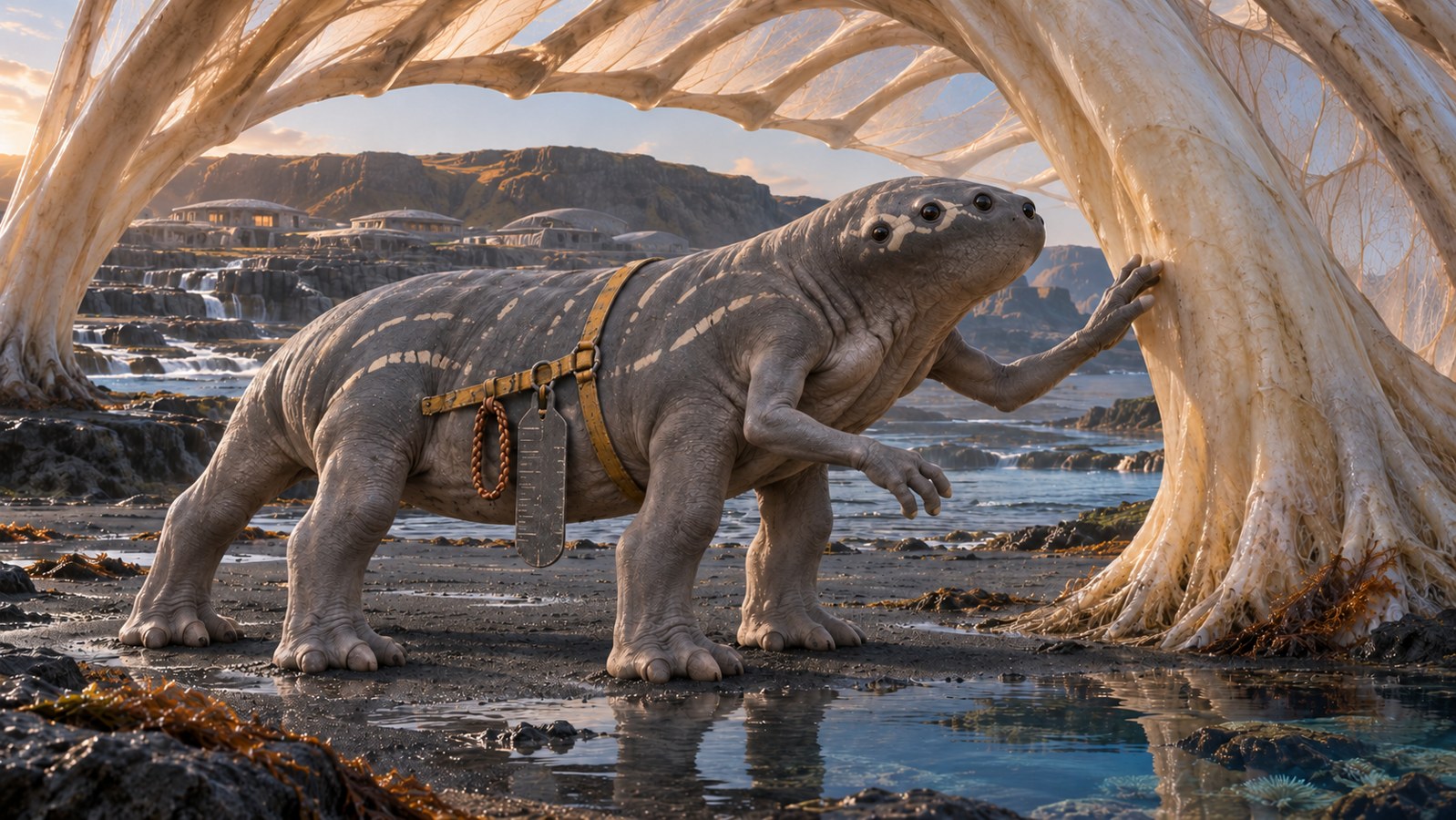
The Vey are intelligent inhabitants with low elongated bodies, four sturdy walking limbs and two smaller manipulating forelimbs. Their six-limbed build changes how they move, make tools and design places to live.
Four small dark eyes sit along a broad sensory crown. Smooth slate-grey skin carries pale markings that shift during communication. They use low resonant sounds, and can detect vibration through contact with the ground. These abilities are part of our fictional design.
They have differing opinions, apprenticeships, responsibilities and jokes. No single character speaks for an entire species.
Meet Seli
Seli keeps the crossing at Nereth inlet. Careful and practical, they know when a familiar sound has gone missing. Their weathered ochre harness carries a slate measuring paddle and braided cord.
Iven, a younger apprentice, asks questions that experience sometimes teaches Seli to stop asking. In the first story, both ways of noticing matter.
A settlement shaped by its inhabitants
Low elongated buildings sit on a basalt terrace above the ordinary flood line. Doorways are broad and low; ramps carry people and loads between levels. Slate, ceramic, braided fibre and glass appear in their everyday tools.
The quickest route crosses the tidal basin. The safer high route follows the ridge. Knowing which route to use is part of living here—and sometimes part of a keeper’s hardest decision.
A world we can return to
Our stories share the same anatomy, materials and geography. Each visit stands alone, while adding to the picture of Nera. This is speculative fiction, not an account of a discovered planet or a model of how alien evolution must proceed.
For real questions about possible environments elsewhere, explore the habitable zone and life in our Solar System.