The tide that failed to return
Every morning, Seli opens the crossing. Today, the water is missing—and something beneath the sand is knocking.
The empty basin
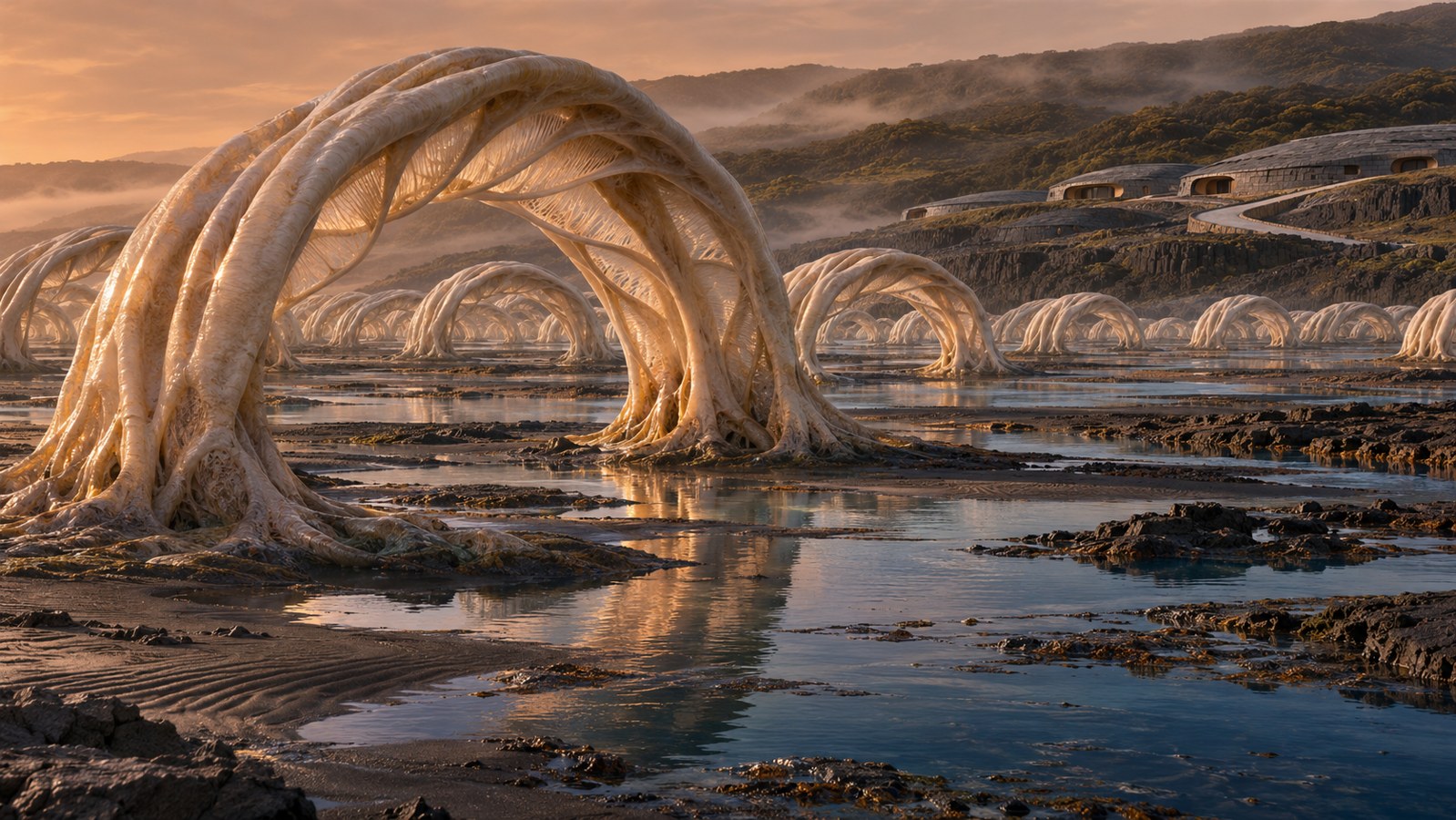
Seli knew the inlet by the sounds it made before sunrise. Water clicking beneath the first arch. Membranes lifting from the sand. The hollow note of the crossing’s lowest marker as the tide reached its rim.
This morning, the marker was silent.
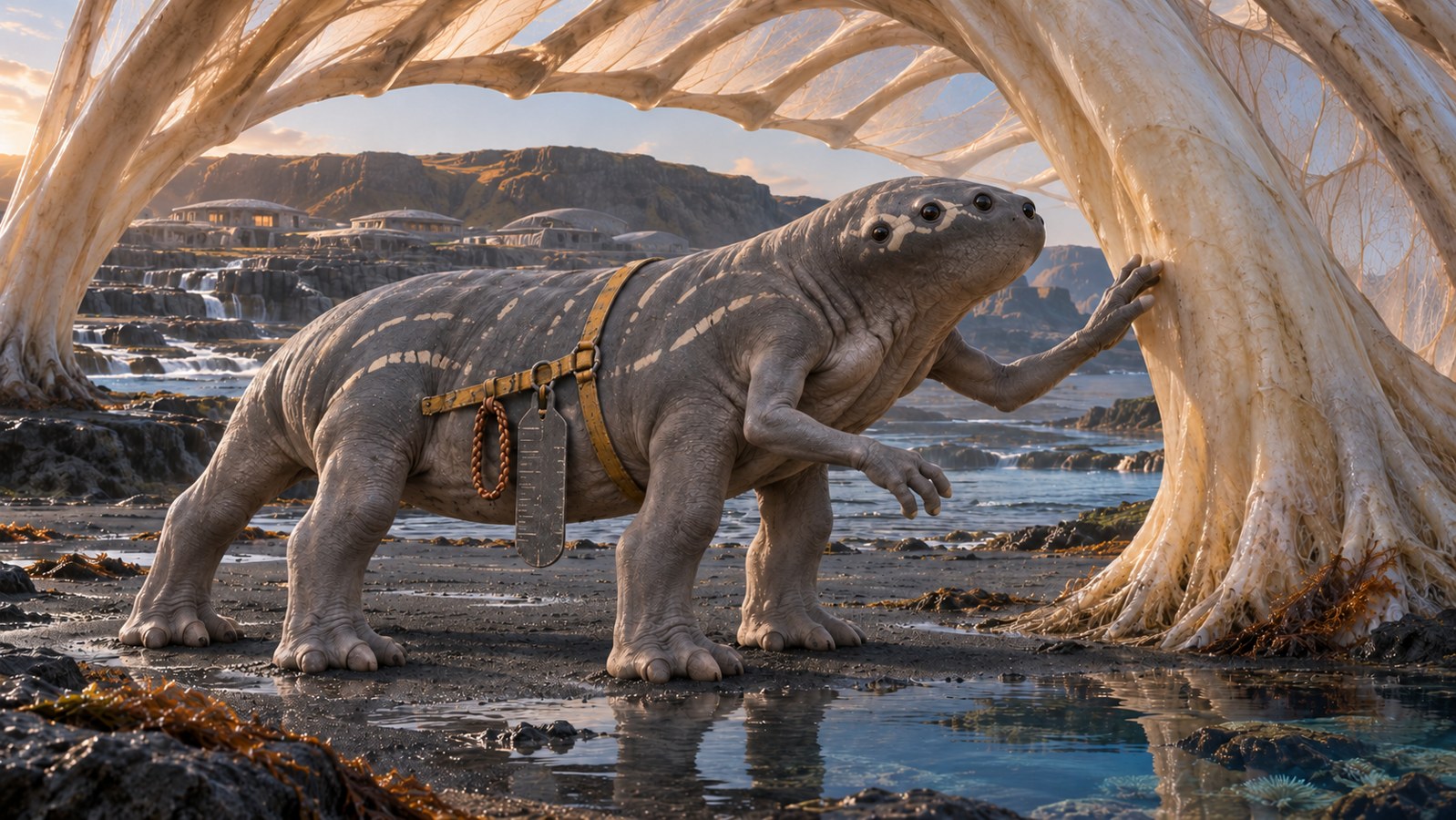
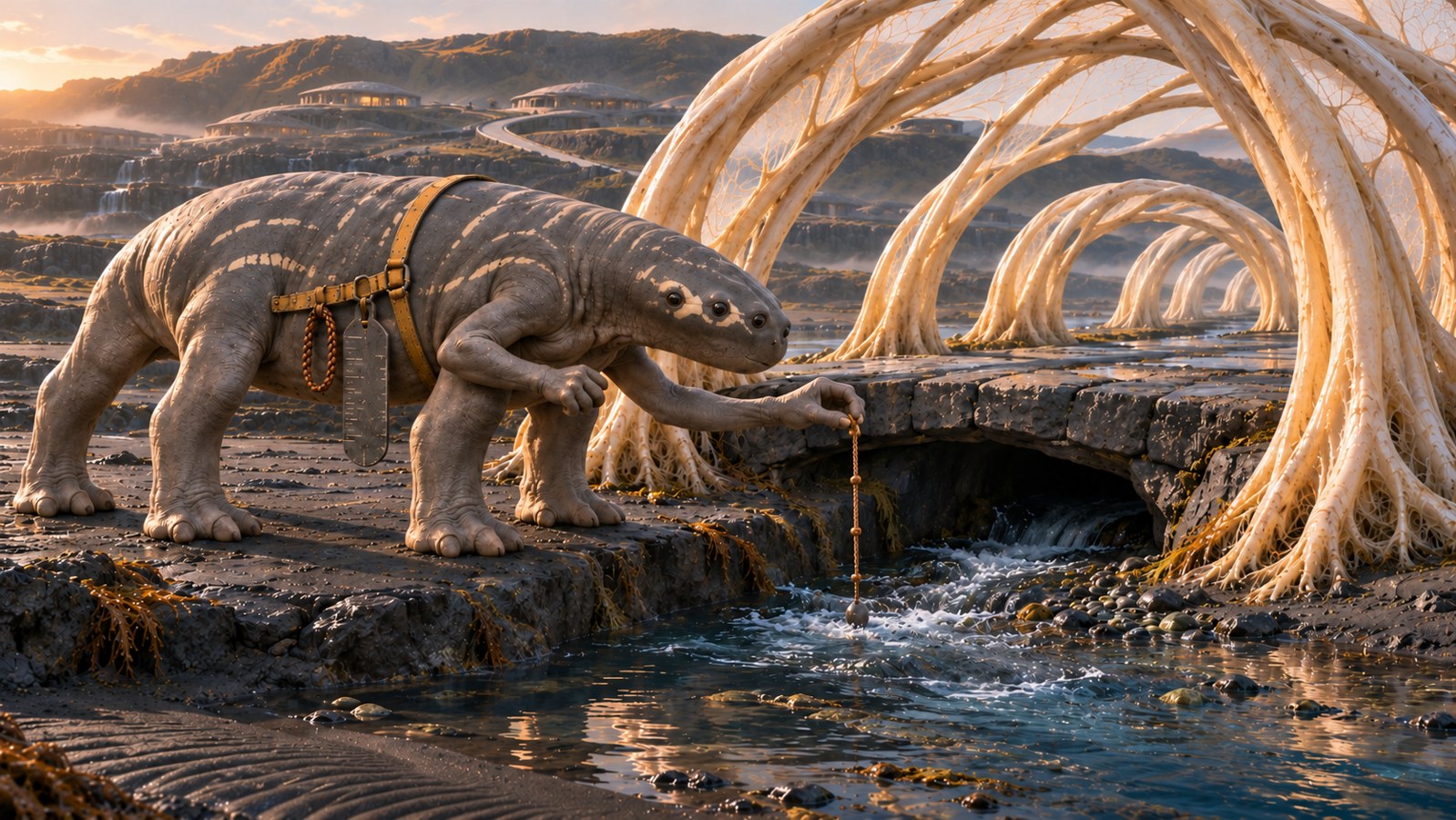
They set four walking feet on the cool basalt and lowered the slate paddle with one of their smaller hands. The measuring cord hung loose. Below it, a blue pool reflected the amber star, but the channel between the pool and the sea lay bare.
Across the flats, the living arches stood open: pale ribbed vaults with their fine filters folded against the inner curves. Their shadows reached towards the settlement on the high terrace.
“Late,” said Iven.
The apprentice had brought the crossing tokens in a ceramic bowl. One for each traveller, to be returned at the far bank. They were already arranging them into neat groups.
“The marker?” Seli asked.
“The water.”
“The marker can be wrong. Go and look at the outer sea.”
Iven’s pale flank line tightened into a narrow band: the expression of someone being sent to check an obvious thing. Seli pretended not to notice.
A road that should have stayed closed
By the time Iven returned, six travellers waited at the first arch. Beyond the inlet, another group had gathered beneath the opposite terrace. Everyone wanted the same thing: the short road across the basin.
“The sea is rising,” Iven said. “Already above the outer notch.”
Seli looked down at the empty channel.
The previous night’s storm had left dark fibre tangled around the arch bases. Usually, the morning tide carried loose material away. Today it lay in ropes across the sand.
“Then we close the crossing.”
One of the travellers gave a low, impatient note. “Because there isn’t enough water?”
“Because there should be.”
The traveller lifted a basket of fired-glass cups. The ridge path was long, steep in places, and unfriendly to fragile cargo. Seli knew. They had carried the same argument across this bank for most of their working life.
They turned the entry token face down.
“Use the ridge. We will help with the baskets.”
At the far bank, Iven raised the closure paddle. The waiting figures hesitated, then began the slow climb.
What the apprentice heard
Iven found the sound while collecting the unused tokens.
A faint knock. Three uneven beats, a pause, then a scrape.
They stood very still, all four walking feet spread across the stone. “Here.”
Seli moved beside them. Through their feet, the vibration was easier to feel than hear. Something was striking the underside of the crossing.
They climbed down the stable side of the bank. Between two arch roots, a narrow opening led beneath the lowest slab. Seli had always thought it was an animal hollow. The keepers before them had filled its entrance with small stones to stop the sand washing out.
Now one stone rolled towards them.
Cold water followed it.
Seli drew back. “Get the bank crew. Nobody comes onto the slabs.”
“What is it?”
“A channel.”
Iven looked from the trickle to the dry basin. “That goes the wrong way.”
“Only if we have the map right.”
Beneath the familiar path
They followed the bank instead of the crossing. At the outer throat of the inlet, the storm’s work became clear.
A thick raft of detached filter tissue, fibre and broken branches had lodged between two fallen pieces of basalt. Beyond it, the sea climbed against the obstruction. On their side, the inlet remained low.
The missing water had found another route.
Under a curtain of old membranes, a dark seam ran towards the crossing. Water pressed into it, carrying pebbles along the buried passage. The knocking was the sound of the inlet trying to fill beneath their road.
Iven’s markings loosened into wide pale patches.
“We’ve been plugging it.”
Seli remembered the small stones they had added last season. A tidy repair. A sensible repair. A repair praised by the terrace steward because the road no longer shed sand.
“Yes,” they said. “We have.”
Making room for the water
The bank crew arrived with hooked poles and two long levers. Seli kept everyone on the high, unbroken rock. They could not lift the fallen basalt. They did not need to.
Working from the bank, they pulled the upper layers of the raft apart. A little water passed through. Then more, pushing the loose fibres downstream.
One pale mass remained caught around a living root.
“Cut it?” asked a crew member.
Seli lowered the slate paddle into the water and traced the attachment. The root was alive. The material around it was not.
“Lift the dead fold. Leave the rib.”
They worked slowly while the outer sea rose. Iven watched the old channel’s mouth and called out each change in flow. Twice, Seli stopped the crew so they could move farther from the edge.
At last the trapped fold tore free.
The first rush filled the ordinary channel with dark, tumbling water. Sand lifted. The arches’ membranes drew inward along their ribs. Behind the crew, the knocking beneath the road weakened to a low rattle, then ceased.
Nobody cheered until the water was safely inside the basin.
A different kind of keeping
By evening, the inlet looked familiar again. Water shone between the arches. The blue pools had joined into one continuous sheet.
The crossing stayed closed.
The terrace steward arrived by the ridge path, carrying the traveller’s basket of cups. One had broken. The steward placed its two pieces beside the unused tokens.
“A costly morning,” they said.
Seli waited.
The steward looked down at the sagging lowest slab. Then they turned the closure paddle so its warning faced the path more clearly.
“It could have cost more.”
After the steward left, Iven opened the keeper’s record. “What do I write? The tide failed?”
Seli watched a loose strand of filter tissue drift through the first arch.
“The tide came,” they said. “We had forgotten one of its roads.”
Iven wrote that down. Under it they drew the old passage, the blockage and the higher path that had brought everyone home.
Tomorrow, the keepers would begin repairing the crossing. Tonight, they let the water use it.
How this world works
Nera, the Vey and the living arches are invented. The missing tide is a local inlet problem: an obstructed channel delays water entering the basin while the sea outside rises. The story does not imagine the planet’s tides suddenly switching off.
The arches are organisms, not conscious floodgates. We gave them rooted ribs and folding filter surfaces, then imagined people whose work requires understanding both those organisms and the movement of water. Their anatomy and ecology are creative choices rather than predictions of alien life.
Meet the Vey · Explore Nereth inlet · Read the factual habitable-zone guide